Field note 01 / Airborne sound
Where airborne sound escapes
When you can hear the words, inspect the route before buying a thicker finish.
Start with an ordinary conversation
Airborne sound begins as a disturbance in air: a voice, a television speaker, a passing vehicle. At a wall, some energy reflects into the room, some is dissipated and some causes the construction to vibrate. That vibration can radiate sound on the other side. An opening gives the sound a more direct route, which is why a small unsealed edge deserves attention.
Choose an everyday, repeatable source rather than a deliberately extreme test. With permission from everyone affected, listen from the receiving room while someone speaks at a normal level next door. Note whether speech is intelligible, merely audible or masked by other sounds. These observations help describe the problem; they are not a calibrated sound insulation measurement.
Move between the centre of the room, the doorway and visible service penetrations. Do not remove electrical fittings or open protected construction. If the noise is strongest at a grille, the ventilation route may need investigation. Never block required ventilation as a shortcut to silence.
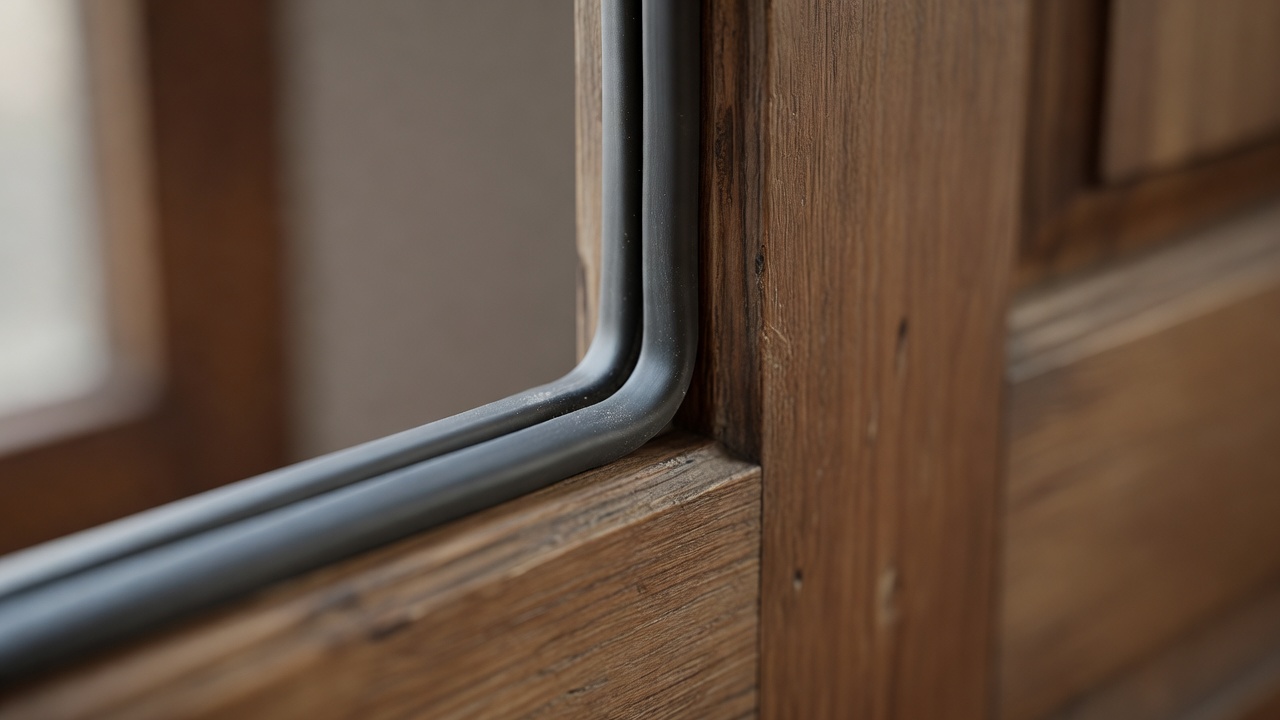
Read the door as an assembly
A heavy door leaf can help resist airborne transmission, but a door is more than its leaf. The frame-to-wall junction, perimeter seals, hardware and threshold all influence the installed result. An uneven floor can leave an inconsistent gap under an otherwise well-fitted door. A worn latch can stop the leaf compressing its seals.
For an internal door that also forms part of a fire or smoke strategy, alterations need particular care. Only use compatible components and obtain competent advice. Acoustic requirements do not cancel fire safety, accessibility or ventilation requirements. A drop seal is not a universal retrofit, and a sealed bedroom door may change how the intended air supply moves through the home.
The best-looking face is not necessarily the best-performing edge.
Mass helps; separation changes the mechanism
A dense lining generally resists sound-driven motion better than a lightweight sheet in comparable conditions. However, real partitions do not behave like a simple weight calculation. Resonances, board fixings, cavities and shared framing all influence performance. Adding board to an unknown wall may improve one frequency range while leaving another weakness unresolved.
A separated double-frame partition aims to reduce rigid connections between its two faces. Mineral wool within a suitable cavity can damp resonant behaviour; it is not a solid barrier on its own. Gypsum plasterboard provides lining mass, while resilient channels or clips can reduce mechanical coupling when they belong to a properly designed system. Screws that bridge the intended separation can undermine that system.
- Source room
speech reaches wall - Direct path
through assembly - Bypass path
around junction
Both routes can be present simultaneously. Treating only the visible wall may leave the bypass unchanged.
What a rating actually describes
ISO 10140 addresses laboratory measurement of sound insulation of building elements. ISO 717-1 describes rating methods for airborne sound insulation, including the weighted sound reduction index, Rw. A laboratory result belongs to the tested assembly and conditions. It is not a promise that any wall using one of its materials will achieve that figure.
Field measurements under ISO 16283-1 assess buildings with their real junctions and flanking paths. A field quantity such as DnT,w is not interchangeable with a laboratory Rw value. Ask which quantity is being quoted, whether spectrum adaptation terms are relevant, and whether the proposed construction matches the evidence. Low-frequency music can remain troublesome even when a single-number rating looks reassuring.
| Observation | Possible route | Useful next question |
|---|---|---|
| Clear speech at the door | Perimeter or threshold opening | Does the complete doorset have suitable evidence? |
| Sound strongest near the ceiling | Shared void or flanking junction | Does the partition continue to the structural soffit? |
| Bass throughout the room | Structural transmission or weak low-frequency insulation | Is frequency-specific assessment needed? |
Make a useful brief
Write down the source, time, receiving room and activities affected. Include drawings or photographs of accessible details, but avoid recording private conversations. State your aim in everyday terms: sleeping without clearly hearing speech, for example. A qualified acoustician can translate that aim into appropriate criteria, investigate the construction and advise whether testing is worthwhile.
The next step is not always a new wall. It may be repairing an established seal, correcting a known gap, reconsidering a speaker location or coordinating a ventilation detail. Seek a whole-path explanation before accepting a product-only answer.
Prepare your room note